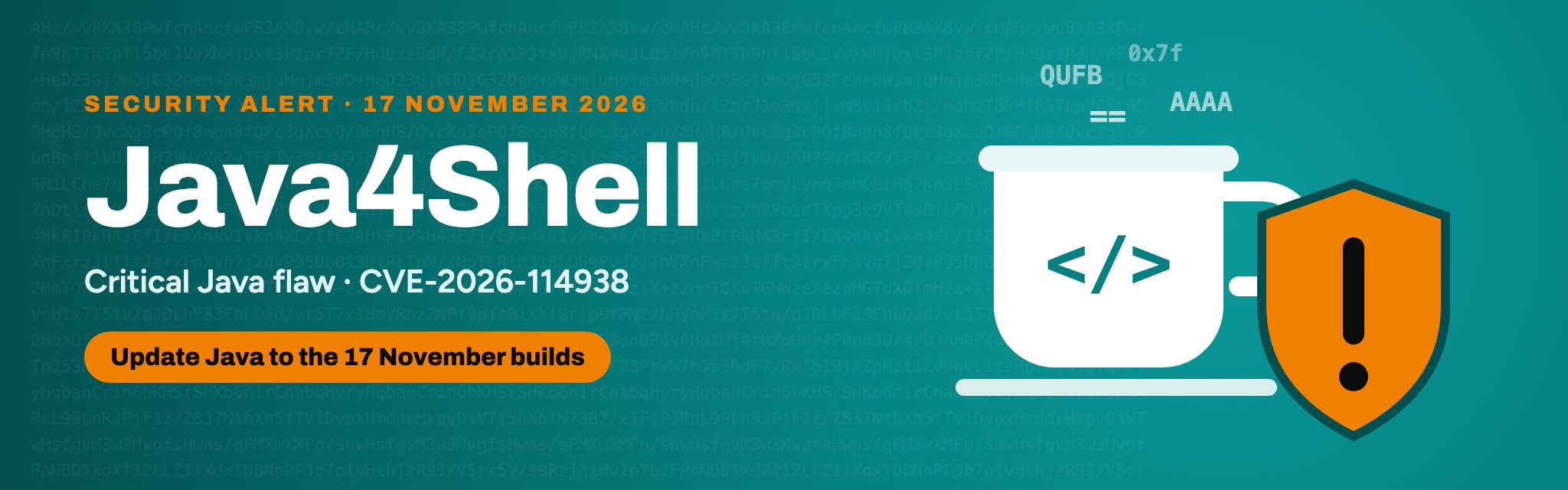
On Tuesday 17 November 2026, Oracle and the other organisations that publish Java released urgent fixes for a serious security flaw. Researchers have nicknamed it “Java4Shell” (its official reference is CVE-2026-114938).
Java is the software engine behind a huge amount of business software, much of it out of sight on servers. So this matters even if nobody in your office has ever knowingly installed Java.
If you are a QLine IT client, the short version is: we checked every computer we manage and all of our own servers the day after the fix came out. Our own systems do not use Java. We found one affected computer across our clients, and that client has been told.
What happened?
The flaw is in a small part of Java that decodes “Base64”, a very common way of packing data so it can travel safely across the internet. On certain modern processors, Java uses a fast, hardware-accelerated version of this decoder. That fast version can be tricked by a specially crafted piece of data into writing outside the memory it is meant to use.
In the worst case, that lets an attacker on the internet run their own commands on a server without needing a password. The researchers who found it, Calif, showed this working before login on well-known products including Jira, Confluence, Jenkins and Keycloak, and say their list is not complete.
How serious is it? Oracle rates it 8.1 out of 10. Calif rates it 9.2 out of 10 (“critical”) using the newer scoring system. Either way, it is near the top of the scale. The US Cybersecurity and Infrastructure Security Agency (CISA) and the Canadian Centre for Cyber Security have both told organisations to patch urgently.
The good news: as of 18 November, there are no reports of anyone using this flaw in real attacks, and the researchers are holding back their detailed attack code to give everyone time to update. That window will not last forever.
Which Java is affected?
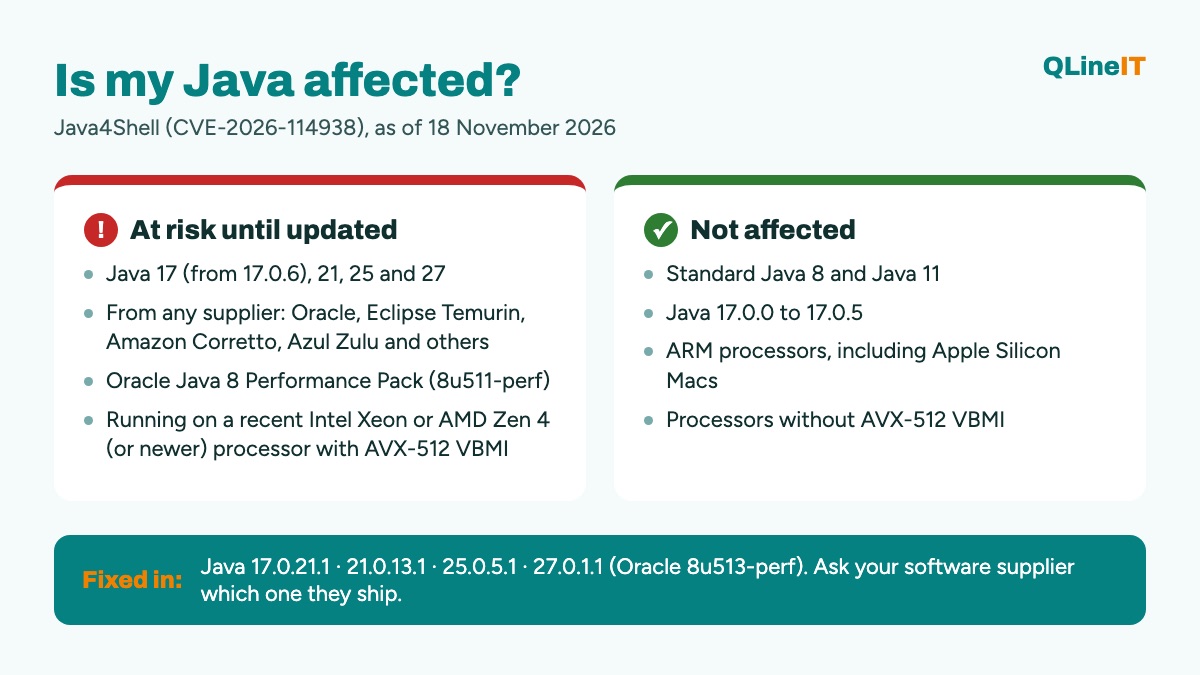
- Affected: Java versions 17, 21, 25 and 27, from any supplier. That includes Oracle’s own Java and the free versions many software companies build on, such as Eclipse Temurin, Amazon Corretto and Azul Zulu.
- Not affected: standard Java 8 and Java 11. The one exception is Oracle’s special “Performance Pack” edition of Java 8, which is affected.
- It also depends on the processor. The faulty code only runs on 64-bit Intel and AMD processors that support a feature called AVX-512 VBMI. That covers many current server processors (recent Intel Xeon and AMD EPYC) and some recent AMD Ryzen desktop and laptop chips. ARM processors, including Apple Silicon Macs, are not affected.
The fixed versions are 17.0.21.1, 21.0.13.1, 25.0.5.1 and 27.0.1.1 (and 8u513 for Oracle’s Performance Pack). Not every supplier had published its fixed version by 18 November, so some people are waiting for theirs.
What QLine IT did
Within a day of the announcement, we checked:
- Our own servers. None of the servers behind our website, client portals and support systems uses Java, so they were never exposed.
- Every computer we manage for our clients. We searched the installed software on more than 1,100 managed computers. We found one affected copy of Java, on a computer used for software development. We have told that client, and it will be updated as soon as its Java supplier publishes the fixed version.
If you are a QLine IT client and we have not contacted you about this, you do not need to do anything. If you run Java-based software that is hosted by someone else, the steps below still apply to that supplier.
What your business should do
Java often hides inside other products, so the main job is finding out where it is. For care homes, pharmacies and small offices, that usually means asking your software suppliers rather than checking computers yourself.
- Make a list of your business software, especially anything that runs on a server or is reached through a web browser: project tools, booking and records systems, document management, single sign-on, and anything your developers or IT supplier set up.
- Ask each supplier for written confirmation. A simple email will do: “Does your product use Java 17, 21, 25 or 27, and have you applied the 17 November 2026 fix for CVE-2026-114938?” Keep the replies; they are useful evidence for Cyber Essentials, NHS Data Security and Protection Toolkit and insurance questions.
- Patch to the 17 November builds anywhere you run Java yourself. Updating the product on top (for example Jira or Jenkins) is not always enough: the Java underneath it must be updated too. If your supplier’s fix is not out yet, ask them what temporary protection they recommend.
- Be wary of emails about the flaw. Big security stories are a favourite subject for phishing. Don’t click links in unexpected “urgent Java update” emails; go to the supplier’s website directly.
- Ask us for a check. If you are not sure whether you use Java, or would like someone to look for you, contact us and we will check your computers and help you word the questions for your suppliers.
IT Solutions
QLine IT is Cyber Essentials Plus accredited and a Microsoft Solutions Partner. We look after businesses, charities, care homes, pharmacies and children’s homes across Leeds and the UK, and we check our clients’ systems as soon as flaws like this are announced. If you would like to talk about your own systems, speak to us.
Sources
- CISA: Critical Java Vulnerability Requires Immediate Patching (17 November 2026)
- The Hacker News: Java4Shell Flaw (CVE-2026-114938) Enables Pre-Auth RCE in Jira, Jenkins, Keycloak and More
- Rapid7: CVE-2026-114938: Reported Critical Pre-authentication Remote Code Execution in Java 17
- Qualys: How to Find, Mitigate, and Patch the Critical Java4Shell Flaw (CVE-2026-114938) Now