When a young person goes missing from a children’s home, the police will ask the same questions every time. What do they look like? What were they wearing? Where might they go, and who with? Do they have a phone? At two in the morning, with one member of staff on a waking night, those answers can take far too long to find.
The Philomena Protocol exists to fix that. This guide explains what it is, what goes on the form and how to keep it useful.
What the Philomena Protocol is
The Philomena Protocol is a form completed in advance for each child or young person who might go missing, mainly children in care. It holds the information the police need to start looking, so that when a child is reported missing, the home can hand it straight over instead of gathering details over the phone.
It was developed by Durham Constabulary and launched there in January 2019, modelled on the Herbert Protocol, which does the same job for adults with dementia who may go missing. It takes its name from St Philomena, a patron saint of babies, infants and youth.
It has since spread well beyond Durham. Many police forces in England use it or their own local version, Police Scotland rolled it out across Scotland in May 2023, and the Police Service of Northern Ireland uses it too. Your local force will tell you which form to use and how to send it.
What the form usually asks for
Each force has its own version, but the forms generally ask for:
- a recent photograph
- a physical description, including height, build, hair, and any scars, tattoos or other distinguishing features
- mobile phone numbers and social media accounts
- friends, family and other people the young person may go to, with addresses where known
- places they are known to go, such as towns, parks, shops or addresses
- previous missing episodes and where they were found
- health needs, including medication they must take
- known risks, such as exploitation, substance use or self-harm
- placement details, including the placing authority and social worker
The young person should be involved in filling it in where that is appropriate. Many will understand why it matters, and they often know better than anyone where they would go.
Why it matters for registered managers
The Guide to the Children’s Homes Regulations says each home’s missing procedures must take account of the police and local authority protocols for missing children in the area where the home is. Where the local force uses the Philomena Protocol, inspectors will expect the home to use it too.
The regulations also require a record of every incident where a child goes missing, including what is known about where they were while they were away (Schedule 3, paragraph 14 of the Children’s Homes (England) Regulations 2015). Ofsted inspectors look at the experiences of children who have gone missing since the last inspection, and they check that return home interviews were offered.
When the young person comes back
When a missing child returns, the statutory guidance on children who run away or go missing from home or care says they must be offered an independent return interview. It should happen within 72 hours of the child returning, and is normally best done by someone trained who is not involved in caring for the child. Arranging it is the placing local authority’s job, but the home should take account of what it reveals when it reviews the young person’s risk assessment.
Ofsted’s inspection framework tells inspectors to report any placing authority that has not offered a return home interview, so keep a record of when it was offered and whether it took place.
Keeping the form useful
A Philomena form filled in on admission and never touched again is not much help. The details that matter most, the photo, the phone number, the friends and the places, change all the time. A few habits keep it current:
- Complete it within the first days of a placement, with the young person if possible.
- Update the photo regularly, and whenever their appearance changes.
- Review it after every missing episode, adding where they were found and who they were with.
- Review it whenever the risk assessment changes.
- Keep it where the person on shift can get it in seconds, day or night, without needing the manager’s login or a key to the office.
Keeping it ready on screen
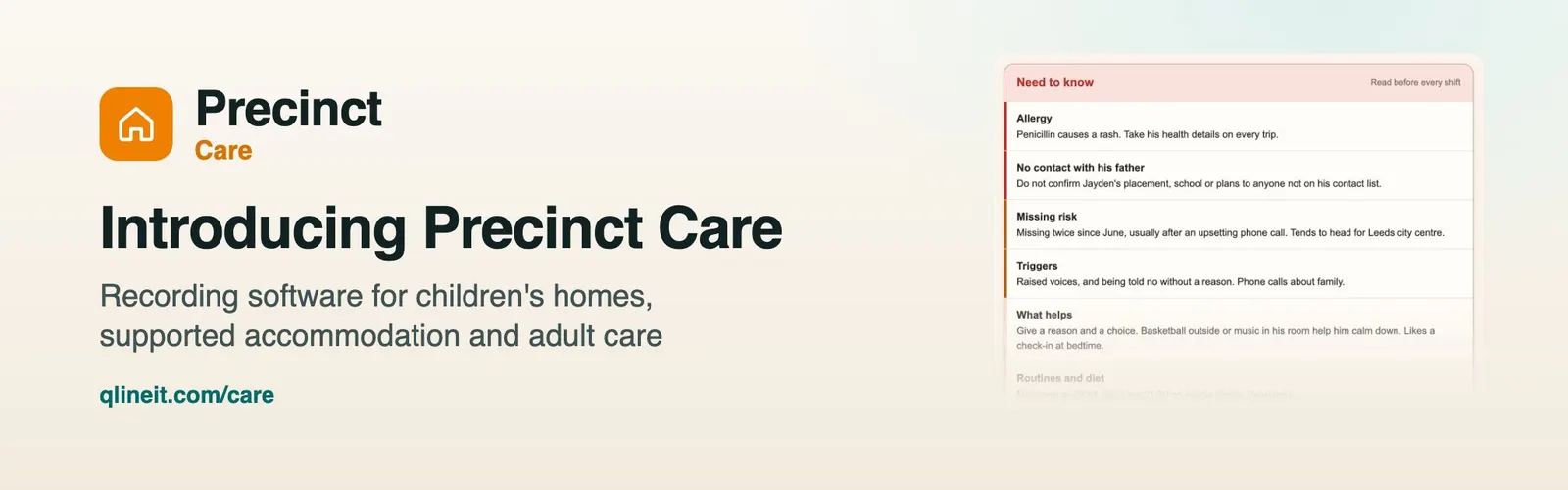
In Precinct Care, the recording system we are developing for children’s homes, the missing person profile is built from the young person’s file and kept ready in the Philomena Protocol format. The person on shift can send it to the police in one step, and the return home interview is tracked afterwards. For adults who may go missing, it uses the Herbert Protocol format instead. Precinct Care is in final development and we are taking a small number of pilot homes.
Read more about missing from care profiles and return home interviews, or book a demonstration.
If a young person has a phone the home manages, we may also be able to help find it: see locating a missing young person’s phone.
Sources
- Children who run away or go missing from home or care: statutory guidance (Department for Education)
- Guide to the Children’s Homes Regulations including the quality standards, paragraphs 9.28 to 9.31 (Department for Education)
- The Children’s Homes (England) Regulations 2015, Schedule 3 (legislation.gov.uk)
- The Philomena Protocol (Police Scotland)
- Social care common inspection framework (SCCIF): children’s homes (Ofsted)