Ofsted inspections of children’s homes are unannounced. There is no notice period to pull files together, so the only real preparation is keeping records in a state you would be happy to show an inspector on any day of the year.
This guide sets out how a children’s home inspection works under Ofsted’s Social Care Common Inspection Framework (SCCIF), what the inspector has already read before they knock on the door, and the records they are likely to ask for.
How children’s home inspections work
Under the SCCIF for children’s homes, last updated on 1 April 2026:
- All inspections are unannounced.
- A full inspection usually happens at least once a year. The inspector is normally on site for up to 2 days, or longer for a home spread across several buildings.
- Homes judged requires improvement to be good usually get a second inspection in the same inspection year, which runs from 1 April to 31 March.
- Judgements use a 4-point scale: outstanding, good, requires improvement to be good, and inadequate. Inspectors first judge how well children are helped and protected, and the effectiveness of leaders and managers, then the overall experiences and progress of children.
- Help and protection is a limiting judgement. If it is inadequate, the overall judgement is inadequate too.
Changes may be coming. Between July and September 2026 Ofsted consulted on reforms to the SCCIF, including a 5-point scale, report cards and dropping the overall experiences and progress judgement. No start date had been announced when we wrote this, so check Ofsted’s website for the current framework.
What the inspector reads before arriving
Inspectors get a day to prepare for a full inspection. They read what Ofsted already holds, including:
- previous inspection reports
- the home’s statement of purpose and children’s guide
- notifications of serious events and what the home did about them
- complaints and concerns
- the monthly regulation 44 independent visitor reports
- the six-monthly regulation 45 quality of care reviews
- changes of manager or Responsible Individual
- any enforcement action in the last year
From this they build lines of enquiry. If your Reg 44 reports or notifications point to a problem, expect questions about it.
Annex A on the first morning
At the start of a full inspection, the inspector sends the manager a link to Annex A, a request for information, and agrees when it will be ready. Ofsted says it is used to check, among other things, that return home interviews are offered after missing episodes, that children get the education and healthcare in their plans, and that staff are working towards the qualifications regulation 32 requires.
You can download Annex A from GOV.UK and keep it updated, which turns a stressful morning into a quick check. If the inspector finds Annex A does not match what they see, they will ask for a corrected version and it may count against leadership and management.
The children whose experiences are sampled
Inspectors evaluate the experiences of a sample of children. It usually includes:
- children who have recently moved in or left
- any child who has gone missing since the last inspection
- any child at risk of, or subject to, sexual or criminal exploitation
- any child living a long way from their placing authority
They always look at any unplanned endings in the last 6 months, or since the last inspection if that is more recent. They may also look at how the home handled a recent serious incident.
The records to have ready
The regulations list what a home must keep. Schedule 3 covers each child’s case record and Schedule 4 covers the home’s other records. In practice, inspectors commonly ask for:
For each child
- care plan from the placing authority, placement plan and reviews
- risk assessments, and how they are used day to day
- daily records that reflect the child’s everyday life and progress
- every missing episode, with where the child was and whether a return home interview was offered
- every use of control, discipline or restraint, with the regulation 35 sign-offs
- health records, including medicines given and any self-administered
- education, including school reports and attendance
- contact arrangements and any restrictions
For the home
- the register of children admitted and discharged
- the staff list, with qualifications and vetting checks, and the planned and actual rotas
- training and supervision records
- the visitors’ book
- fire drill and alarm test records
- the location assessment, updated at least yearly
- notifications to Ofsted and the outcomes
- complaints and how they were resolved
- regulation 44 reports with the manager’s responses, and regulation 45 reviews
Ofsted says inspectors do not routinely read every policy, and that they care about whether documents work in practice, not their format. Electronic records are fine as long as they meet the regulations, children can see their own records if they want to, and staff can get to what they need. The inspector may need someone to show them round the system.
The questions behind the records
Records are evidence, not the point. Behind every request is a question about a child’s experience. Did the restraint records show staff trying the child’s own calming strategies first? Did the missing records lead to a change in the risk assessment? Did the manager respond to what the Reg 44 visitor found? Being able to answer those questions from the records, quickly, is what good preparation looks like.
Giving the inspector their own view
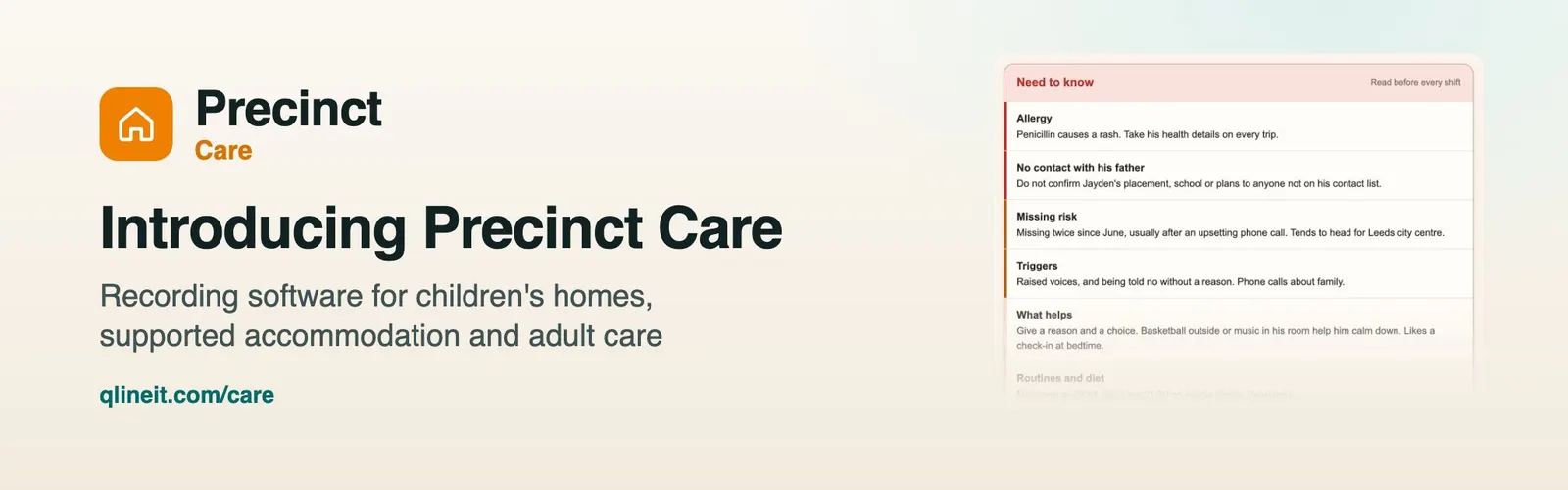
In Precinct Care, the recording system we are developing for children’s homes, an inspection pack is kept ready all the time: children placed, incidents, physical interventions, missing episodes, notifications and Reg 44 actions since the last inspection. The manager can give the inspector read-only access for the inspection days, with every page they open recorded. Precinct Care is in final development and we are taking a small number of pilot homes.
Read more about Ofsted inspection access and the inspection pack, or book a demonstration. For the online safety part of an inspection, see what Ofsted inspectors ask about internet filtering and monitoring.
Sources
- Social care common inspection framework (SCCIF): children’s homes (Ofsted, updated 1 April 2026)
- The Children’s Homes (England) Regulations 2015, Schedule 3 and Schedule 4 (legislation.gov.uk)
- Ofsted consults on strengthening children’s social care inspections (Ofsted, July 2026)
This guide covers children’s homes in England.