Ofsted has consulted on the biggest change to how it reports on children’s homes since the social care common inspection framework (SCCIF) began. The single headline judgement would go. Instead, each home would get a report card, with its own grade for each area on a new five-point scale, and a new area on children’s enduring relationships.
The consultation ran from 7 July to 28 September 2026. Ofsted is now analysing the responses and expects to publish its response in early 2027. Nothing has changed yet: inspections today still use the current SCCIF and its four grades.
This guide sets out what Ofsted proposed for children’s homes and other SCCIF providers, what is still undecided, and what registered managers can sensibly do now.
What a report card would look like
Ofsted proposes online report cards in place of today’s reports. Each would start with a simple colour-coded grid showing the grade for each evaluation area. Under the grid would be a short summary of what the findings mean for children and families, then a section for each area, with more detail you can open, and key facts and figures about the home.
The summary at the top would have no grade of its own. Ofsted’s aim is to move beyond one headline judgement towards reporting that reflects how complicated children’s social care is.
The new five-point scale
The current four grades, from outstanding to inadequate, would be replaced by five:
- Exceptional
- Strong standard
- Expected standard
- Needs attention
- Urgent improvement
Ofsted proposes a “secure fit” approach: to get a grade, a home must meet all of the criteria for that grade. That is stricter than today’s best fit, and Ofsted says the new grades will not be directly comparable with the old ones. A “good” home today will not automatically be at “strong standard”.
The evaluation areas
Ofsted proposes to keep the three existing graded areas and add a fourth:
- the experiences and progress of children
- children’s enduring relationships (new)
- how well children are helped and protected
- the effectiveness of leaders and managers
Each area would be graded on its own. Today, a weak judgement on how well children are helped and protected limits the overall grade. Without an overall grade, Ofsted says no grade would automatically affect another. Inspectors would still take account of whether leaders know about any shortfall.
Independent fostering agencies would also get an area on recruiting, assessing and supporting foster carers. That does not apply to children’s homes.
Children’s enduring relationships
The new area is the one most managers ask about. Ofsted’s stated ambition is that its inspections have children’s enduring relationships “as a central focus”. It sits alongside the Department for Education’s work on enduring relationships for care-experienced children.
Ofsted says it is still working with the Department for Education on how to measure this area, so the criteria are not settled. In practice it is likely to cover the things that make relationships last:
- family time, and how the home supports it
- the people who matter to each child, and whether the home knows who they are
- keyworker continuity, and how often key adults change
- helping children stay in touch when they move on
Most homes already record some of this. The question is whether you could show it, child by child, if an inspector asked tomorrow.
When it could start
Ofsted proposes to phase in the SCCIF changes between spring 2027 and spring 2028, starting with small-scale testing with providers. A timeline for each type of provider will follow the consultation response, and the dates may move depending on the Department for Education’s reforms.
Some of the changes also need the law to change. Removing the overall judgement depends on the Department for Education amending the regulations on inspection fees and frequency, including a new trigger for inspecting a children’s home more than once a year. Ofsted proposes that a “needs attention” grade in any area would bring the next inspection forward.
What it means for registered managers
The changes are not final, but the direction is clear, and none of it is wasted effort under the current framework:
- Know your evidence by area, not just overall. Grading each area separately means a strong home can still have one area marked “needs attention”. Look at each area on its own.
- Start recording enduring relationships properly. For each child: who matters to them, how family time is going, how long their keyworker has been with them, and what is planned for staying in touch when they move on.
- Expect a higher bar for each grade. Under secure fit, one missing criterion is enough to drop a grade. Test your self-evaluation against every point, not the overall picture.
- Keep your Reg 44 and Reg 45 reports sharp. Inspectors read them before they arrive. Reports that say what the independent person really thinks, with the manager’s response to each recommendation, will matter as much as ever. Our free Reg 44 visit report template follows the regulation.
- Watch for the response. Ofsted expects to publish it in early 2027, with the final criteria and timeline.
Rehearsing in Precinct Care
We have built a “report card readiness” view into Precinct Care, the children’s home recording system from QLine IT and Precinct Software. For each proposed area it counts the home’s records and suggests a point on the proposed scale, and the registered manager decides. A children’s enduring relationships view shows, for each child, the people who matter to them on file, their keyworker, how long they have lived at the home and the keywork recorded.
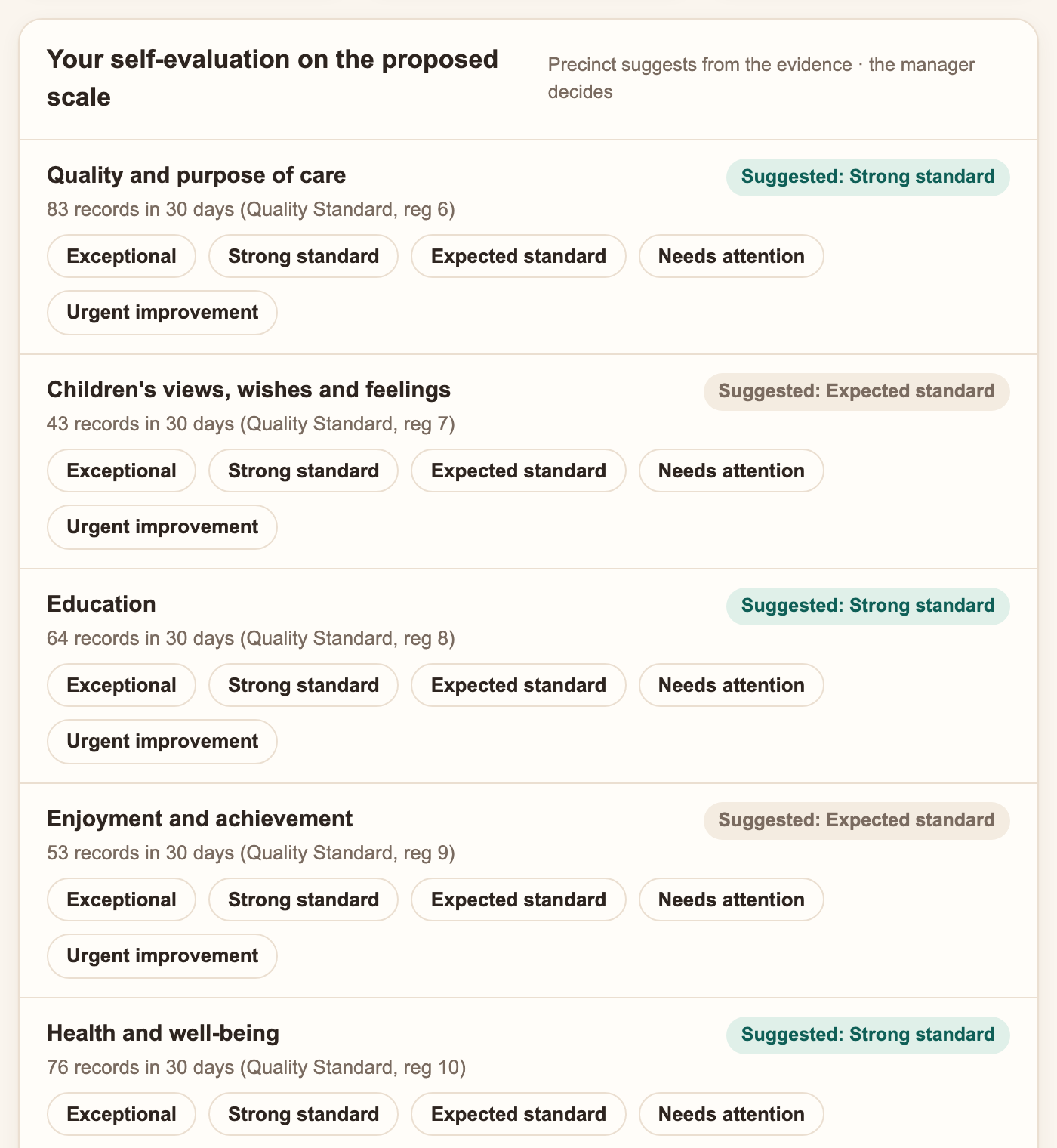
It is a rehearsal on Ofsted’s proposals, not the final framework. We will update it when Ofsted publishes its response. Read more about Ofsted inspection access in Precinct Care, see our free templates for children’s homes, or book a demonstration.
Sources
- Improving the way Ofsted inspects children’s social care (Ofsted consultation, 7 July to 28 September 2026)
- Consultation document (Ofsted, 7 July 2026)
- Social care common inspection framework (SCCIF): children’s homes (Ofsted, updated 1 April 2026)
This guide covers children’s homes in England, based on Ofsted’s proposals as consulted on. Wales and Scotland have their own inspectorates. We will update it when Ofsted publishes its response.